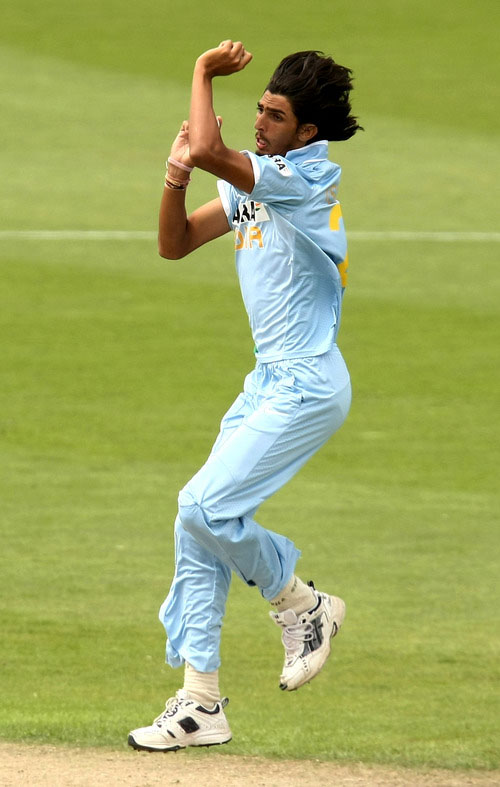
Sport is definitely run on the skills of a player, however sometimes it is the physical attributes that matter for their success. Some players are born with that special abnormality of being extremely tall and it does make a difference in cricket, and not in just basketball or volleyball!
Usually it is bowlers who are tall and thus extract a tremendous amount of bounce on a pitch to make cricket, which is said to be a batsman’s game more fascinating to watch.
Here is the list of 10 Tallest Cricket Player of all time.
1) Mohammad Irfan (Pakistan) – 7′ 1″

7′ 1″ Mohammad Irfan is the Tallest Cricket Player of All Time
The lanky Pakistani quickie was born on June 6, 1982 in the eastern Pakistan town of Gaggu Mandi in Punjab. Although his height has been under some speculation for a while, Mohammad Irfan himself has confirmed that he is 7 foot 1 inch tall which easily makes him the tallest cricket to have played cricket till date, surpassing his idol Joel Garner.
The lack of employment opportunities in his home town forced him to quit playing cricket temporarily and he started working in a plastic pipe factory to support his poor family. But he never gave up his dream of playing cricket and the legendary Aaqib Jawed first spotted his talent in the game and called him to the National Cricket Academy in Lahore. In no time, he began playing first-class cricket for Khan Research Laboratories. He took nine wickets in his second game and ended the season with an impressive 43 wickets in ten games in the Quaid-e-Azam Trophy in October 2009.
He made his ODI debut for Pakistan on September 10, 2010 against England after the removal of Mohammad Asif and Mohammad Amir from the squad on the tour of England for the ODIS, following the spot-fixing controversy. But it was not a memorable start to his career as he gave away 37 runs in 5.3 overs without picking a wicket and had to leave the field midway due to cramps. England went on to win the match by 24 runs.
He may hope to make a regular place in the Pakistan team in the near future but in the IPL, he has greater chances to appear after having signed an MOU with the Kolkata Knight Riders for the 2011 season on the recommendation of their bowling coach and Pakistan legend Wasim Akram. Though, the validity of this contract will depend on the BCCI allowing Pakistani players to feature in the IPL and the Pakistan Cricket Board giving its final approval as well.
2) Joel Garner (West Indies) – 6′ 8″

Joel Garner – Tallest West Indies Cricket Player of All time
Also known as ‘The Big Bird’ for the fact that he is a predecessor to other Caribbean pacers, Garner was born on December 16, 1952 in Barbados. He was a 6 feet 8 inches fast bowler highly known for demoralizing opposition batsmen with the steep bounce he generated time and again. Working in tandem with the likes of fellow quickies such as Michael Holding, Andy Roberts, Colin Croft and a little later Malcolm Marshall, the West Indies were easily the worlds No.1 Test and ODI team in the 70s and 80s, even if they lost the 1983 World Cup final to India. But they did not lose a single Test series for a span of 15 years.
Joel Garner played in 58 Tests between 1977 and 1987 and took 259 wickets at an average of slightly over 20, making him one of the most efficient fast bowlers of all time
But it was in ODI cricket that he put his height to use with devastating effect.
In 98 matches he took 146 wickets. He had the ability to unleash a toe-crushing yorker time and again and obviously generate more bounce.
He is amongst the only two bowlers with more than 100 ODI wickets to average under 20, while his economy rate of slightly above 3 runs per over combined with taking 100+ ODI scalps, are also the best ever for any bowler. His most memorable spell was the 5 for 39 he achieved in the 1979 Cricket World Cup final against England remains one of the best ever bowling performances in a final..
Joel Garner represented Barbados in the West Indies, South Australia in Australia and Somerset in England alongside other greats such as fellow West Indian Viv Richards and Ian Botham. He was at Somerset in the most successful time in the county’s history.
3) Bruce Reid (Australia) – 6′ 8″

Bruce Reid – The Tallest Australian Cricket Player
Bruce Reid shared the same height as Garner, making him the joint second tallest cricketer to have played the game at international level. He was born in the land of fast bowling in Australia, i.e, Perth on March 14, 1963 and as a result played for Western Australia in the Australian domestic competition.
As a lofty and gawky left-arm pace bowler, he made his international debut alongside the likes of Merv Hughes and Geoff Marsh in 1985-86 when Australia were in a slump. His ability to straighten the ball in to the right-hander as well as slant it away to an extent, and with naturally steep bounce, made him instantly Australia’s mainstay. His ultimate achievement was to take 13 wickets against England in the Boxing Day Ashes Test at Melbourne in 1990-91.
He represented Australia in Test cricket between December 1985 and December 1992 and in ODIs between January 1986 and March 1992.
He played 27 Tests for Australia taking 113 Test wickets at an average of 24.63 runs per wicket. He also played 61 one-day-internationals taking 63 ODI wickets. But being very thin in build, he frequently broke down with injuries and was rarely fully fit and perhaps Australia lost another potential bowling legend. Though he was an integral part of the 1992 World Cup team, which eventually failed in the tournament held at home for the first time in their cricketing history.
After retirement, Bruce Reid came in the headlines again for being the bowling coach of the Indian team for the tour of Australia in December 2003 as his contribution was vital in India leveling the 4 Test match series at 1-1.
4) Curtly Ambrose (West Indies) – 6′ 7″

Curtly Ambrose – Man of few words – “Curtley Talk to no man”
He is the second West Indian to make this list. Curtly Ambrose was born in Antigua on September 21, 1963 and made his Test debut against Pakistan in Guyana in 1988 and his ODI debut against the same opposition in the same year but in Jamaica.
His skill was as a right-arm fast bowler, especially with his partner-in-crime being Courtney Walsh. With Walsh, he formed one of the greatest opening bowling partnerships in history, as evidenced by the 421 wickets they shared in the 49 Test matches they played together.
His colossal 6’7″ frame was a threatening sight for any batsman and although his pace fell away due to age, he still bowled excellent line and length and, due to his height, could extract humungous bounce from any pitch which is a danger to even some of the finest batsmen of all.
Curtly Ambrose was a man of few words, refusing countless interview requests with the motto “Curtly talk to no man” although he was involved in a clash with Steve Waugh in 1995 in the Frank Worrell Trophy played at home. Yet his actions spoke louder, not to mention his menace.
Among the highlights of Ambrose’s 405 Test wickets at a miserly average of 20.99, two spells were his best. Tthe 6 for 24 that blew England away for 46 at Port of Spain, Trinidad in 1993-94, and his series-winning 7 for 1 against Australia at the WACA the previous season. The WACA pitch was ideal for a man who stood 6ft 7ins and released the ball from almost 10ft high, making it look like a springboard in action on the cricket field.
Now Curtly Ambrose has become a musician, but still regrets not being a part of a West Indies side which lost a won semifinal to Australia in the 1996 World Cup.
5) Tom Moody (Australia) – 6′ 7″

Tom Moody
Tom Moody was born in Adelaide on October 2, 1965. He was tall in terms of both his height and playing structure. He got rid of tentativeness against short bowling in the initial stages of his career, only to become a batsman who looks at his prime while hitting through the covers and down the track with immaculate power.
He was also a more than a part-time, bowling medium-pace often and also swung the ball to an extent, a safe slip fielder and a natural leader which was seen more in domestic cricket that he played for Western Australia and Worcestershire.
His short Test career did not take off after he was sacrificed as an opener in Sri Lanka in 1992-93, though he made a memorable comeback to the one-day team in time to play in, and contribute measurably to, Australia’s 1999 World Cup win. He and Steve Waugh became the first two Australians to win two World Cups and this is something he will always be proud to have achieved.
He appeared in 8 Tests and 76 ODIs for Australia from the period of 1989 to 1999. His career was cut short by a back injury which is perhaps due to his height and so had to prematurely take up retirement.
But Moody remains active in the world of cricket after being Sri Lanka’s coach from 2005 to 2007, guiding them famously to the 2007 World Cup final and then being the coach of the Kings XI Punjab in the IPL from 2008 to 2010. He also appears on television as a cricket expert for several series these days.
6) Jacob Oram (New Zealand) – 6′ 6″

Jacob Oram
Another career which has been drastically hampered by height. But Jacob Oram has never failed to entertain Kiwi fans when he takes the field being fully fit. He has a high degree of agility in the field, where his skills were developed as a schoolboy representative soccer goalkeeper, and he complements that with solid medium-fast bowling skills and a naturally aggressive approach with the bat. Usually batting in the middle to lower order, Oram’s bowling has been more successful in the shorter format—reaching as high as 5 in the ICC ODI Player Rankings
He is one of the 36 New Zealand cricketers to have scored 1,000 runs in Test match cricket and one of the six New Zealanders to have reached the double of 1,000 ODI runs and 100 wickets.
In 2003–04, he fell agonizingly short by 3 runs of a maiden Test hundred, with 97 against Pakistan. But he was able to bring up his first Test against South Africa. His second Test hundred was 126 not out against Australia in Brisbane having the likes of Shane Warne and Glenn McGrath in 2004. His 3rd Test hundred was against South Africa, with a career highest of 133 out of the five Test hundreds he has scored till date.
On 28 January 2007, in Perth, Oram smashed an unbeaten 101 off 72 balls in an ODI against Australia. It was at the time the fastest ever ODI century by a New Zealander, and also the fastest ever made against Australia. His 137 run partnership with Brendon McCullum was, at the time, the highest ever for the New Zealand 6th wicket, though this record was broken the following month.
On 2 September 2009, Oram took a hat trick against Sri Lanka in a Twenty20 International in Colombo, dismissing Angelo Mathews, Malinga Bandara and Nuwan Kulasekara which is an honour to possess considering the format suiting batsmen more than the bowlers while in the 2011 World Cup, he took a spectacular catch at the boundary to assist New Zealand in choking South Africa to a shock quarterfinal defeat.
Now he plays for New Zealand in the shorter formats of the game, Central Stags in the New Zealand domestic championships and Rajasthan Royals in the IPL.
7) Abey Kuruvilla (India) – 6′ 6″

Abey Kuruvilla – India’s Tallest Cricket Player
Possibly the tallest player to play for India at 6′ 6″, he was born in Mannar, Kerala on August 8, 1968. Abey Kuruvilla, in spite of his well endowed physique, was not an express bowler. He thrived on his ability to swing the ball and later developed variations such as a well disguised slower delivery, he had his grounding under the mentoring of Frank Tyson as part of the BCA-Mafatlal Bowling Scheme.
Abey Kuruvilla took 35 wickets in his first full season for Bombay in 1991-92 and although widely expected to make the tour of South Africa in 1992-93, he was unfortunately not selected in the final squad.
India’s perennial problem has been, to find a quality pace bowler. That made the Indian selectors selectors finally gave the lanky Mumbaikar a chance to don the national colours on the 1996-97 West Indies tour. Abey Kuruvilla emerged as a key figure in the Indian attack and a haul of 5 for 68 in the second innings of the third Test at Barbados set up a winning position for India as they only had to score 120 to win, but the batsmen unfortunately messed it up all. He went on to play just five more Tests against Sri Lanka at home and away in the following season where he did perform reasonably well considering the flat wickets in the Indian subcontinent but, shockingly, he was never considered again to play for the country.
He retired from first class cricket after the 1999-2000 Ranji Trophy final against Hyderabad and ever since has looked to take up coaching assignments.
8) Peter Fulton (New Zealand) – 6′ 6″

Peter Fulton – “2 Meter Peter”
Peter Fulton is a tall middle-order batsman nicknamed “Two-Metre Peter”, and was born in Christchurch on February 1, 1979. He initially made his mark on first-class cricket by extending his maiden century to 301 not out for Canterbury against Auckland in March 2003, in only his second full season.
The following season he scored consistently, making 728 runs at 42.82, including two more centuries, and – after a consistent tour of South Africa with New Zealand A – was finally called up to New Zealand’s one-day squad for the tour of Bangladesh in November 2004. He played one match there, but it was another one year before he cemented a place in the national side, with 70 not out, 32, 50 and 112 against Sri Lanka. Wisden was perhaps too early to call him “one for the future, provided he could retain his simple, uncomplicated batting style”.
After being overlooked for New Zealand’s initial World Cup games in March 2007, Fulton replaced Lou Vincent who had to fly back home. Fulton grabbed this opportunity and was his team’s top scorer in three matches, including a lone hand of 62 as New Zealand crumbled against archrivals and eventual champions Australia. He finished the tournament third on the side’s run tally, with 297 runs at a decent average of 37.12.
Fulton however is a classic example of a talent wasted due to inconsistency just as Mohammad Ashraful of Bangladesh and was dropped from the side in 2009. But he is one of the few New Zealand batsmen to have gone past 1000 runs in ODIS as he averages 32.53 while in Tests he has only managed 314 runs at an average of 21.
9) Morne Morkel (South Africa) – 6′ 5″

Morne Morkel
Morne Morkel, the younger brother of allrounder Albie, is an out-and-out fast bowler who has not just the height but also a tremendous amount of pace to trouble the best of batsmen.
Morne Morkel was born in Vereeniging, Transvaal on October 6, 1984 and made his first-class debut in 2003-04, earning promotion to the Nashua Titans in the 2006 domestic season. A certain Allan Donald, ‘The White Lightening’ marked him out as a national-level player of the future with high praise for the gawky fast bowler’s ability to extract bounce and bowl genuinely fast.
The highlight of the 2006-07 home season was India’s tour of South Africa and Morkel used the opportunity to play for Rest of South Africa against the tourists to achieve a spot in the Test sdie. On the opening day of the four-day fixture at Potchefstroom, Morkel ripped through the Indian top order with 4 for 29. That showing earned him a Test call-up which he was aiming for, and he made his debut in the second Test at Durban when Dale Steyn was ruled out, showing good application in an unbeaten 32, shepherding his fellow tail-enders, and pushing South Africa on to a score that seemed scarcely probable earlier in the match. He added three quick wickets on day three to help South Africa to a fantastic win, but missed out on the final Test at Cape Town.
He did have a quite 2008 but then roared back into form the following year with the home series against England being one of the highlights as Morkel famously got the wicket of the obdurate Ian Bell in the second last over of the final day of the Cape Town Test match and consequently, South Africa won to draw level the series.
Since then, he has formed the best new-ball pair in the contemporary era with Dale Steyn, especially in Tests and that has been the main reason why South Africa is ranked in the top 3 Test and ODI teams of the world. Morkel’s achievements grabbed the eyeballs of the Rajasthan Royals in the first three years of the IPL and the Delhi Daredevils in 2011 and his participation in the IPL subsequently has made him sharpen his bowling skills. While in English domestic cricket, he plays for Yorkshire while in South Africa, he turns out for the Titans in the domestic championships.
10) Ishant Sharma (India) – 6′ 5″

“Lambu” – Ishant Sharma
Ishant is fondly called ‘Lambu’ or ‘Tall’ by his friends and family members back home in Delhi and they have a fair reason to call him so. Born on September 2, 1988 in the Indian capital, Ishant plays for them in the Ranji Trophy but has featured in the IPL for Kolkata and Hyderabad in the last four years.
With a physique and attitude that reminds many of a young Javagal Srinath, he has a high arm delivery action and is not a swinger of the ball but depends a lot on pace and movement off the seam.
Ishant Sharma made his Test debut against Bangladesh in May 2007 in Dhaka and his ODI debut was against South Africa in Belfast the same year. But it was not until the tour of Australia in December 2007 that the world saw the ‘real’ Ishant Sharma. He caught the attention of everyone in the Test series, with greats such as former Australian captain Steve Waugh calling him ‘the next best thing in Indian cricket’ while Adam Gilchrist in what was his last Test series for Australia, described his bowling as ‘lethal’. His menacing spell to the then Australian skipper Ricky Ponting at the WACA, Perth was the talk of the nation in the days to come and proved the stuff he was made of.
He continued to impress in the one-day series, clocking more than 150kph once, and ended as India’s highest wicket-taker in the triumphant campaign. These performances were crucial in earning him a place in the Kolkata Knight Riders roster in the first 3 years of the IPL, and being an 18-year old he was auctioned for $950,000, which was the highest paid for any bowler in the world then.
His performances were consistent in the next 12 months that followed the Australia tour, with South Africans too facing his pace with not much success and Australia again suffered, when they came on the return trip to India with Ishant winning the man-of-the-series award with 15 wickets in 4 Tests, being only the second Indian fast bowlers to win that award after Kapil Dev in India. But come 2009 and his form slumped to a huge extent as he lost his potent weapon – pace and since then has struggled to return to what he was on his debut.
Though, Ishant Sharma had a wonderful 2011 ending with 43 wickets in Tests being the second highest wicket-taker in the world after Pakistan’s Saeed Ajmal. He has immense talent in him to be India’s permanent bowling spearhead in the absence of Zaheer Khan and having played 43 Tests and picked 131 wickets, to pick the likes of batters such as Ricky Ponting 8 times and Michael Clarke 6 times is no mean achievement. The only obstacle in his success would be a poor record in the shorter formats of the game as he only has 64 wickets in 47 ODIs at a poor economy rate of 5.72.
There are several other cricketers such as Will Jefferson from England who has a massive height of 6 feet 10 inches but is a county cricketer and so has not been considered in this list. While international cricket has seen other tall players such as Steve Harmison, Andrew Flintoff, Ashley Giles and Glenn McGrath in the contemporary era. But the above mentioned 10 cricketers are said to be the tallest ever when it comes to playing cricket as of now, even as this list could see some changes in the years to come.